
The United States is home to many globally recognised universities and colleges, offering international students a wide range of academic programmes and study opportunities.
One of the key features of the US education system is its flexibility. Students can explore different subjects, choose their area of specialisation and develop practical skills alongside academic knowledge.
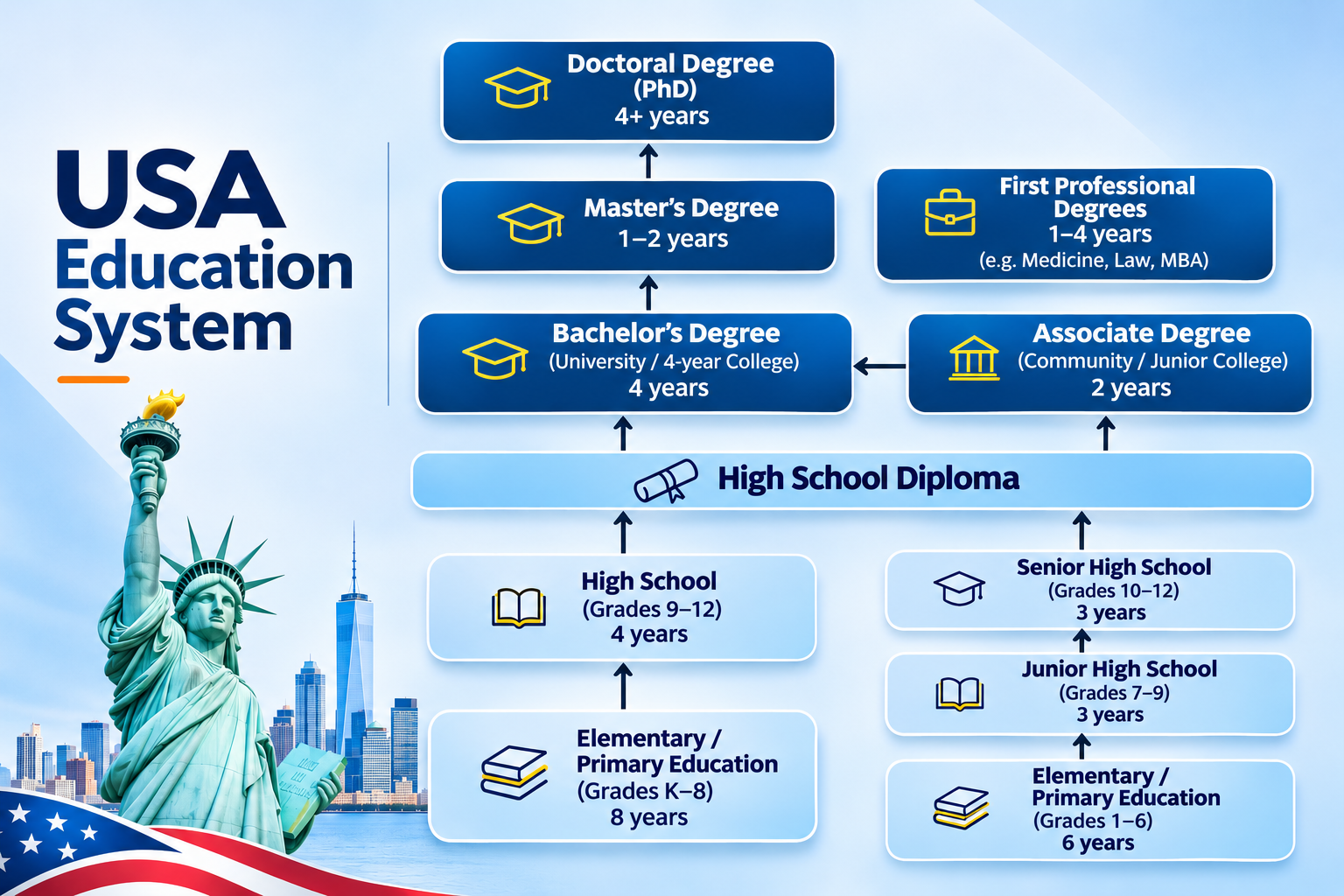
The education system is broadly divided into primary education, secondary education and higher education.
School education in the United States generally follows the K–12 system, covering Kindergarten through Grade 12. Public school education is generally tuition-free for eligible students, although some additional expenses may apply.
The structure can vary between states and school districts, but typically includes:
Students who successfully complete Grade 12 and meet their school's graduation requirements receive a High School Diploma, which is commonly required for admission to undergraduate programmes.
The United States offers a diverse higher education system, with public and private universities, community colleges, liberal arts colleges and specialised institutions.
Students can choose from programmes in engineering, computer science, business, healthcare, arts, sciences and many other disciplines.
Higher education institutions generally fall into the following categories:
Community colleges typically offer two-year Associate Degrees, along with certificates and career-focused programmes.
Students may also use the 2+2 transfer pathway, completing approximately two years at a community college before transferring to a four-year university to complete a Bachelor's Degree.
This can be a more affordable route to undergraduate education, although transfer admission and credit recognition depend on the receiving university.
Vocational and technical institutions offer practical, career-focused education designed to develop specific occupational skills.
Programmes may include culinary arts, automotive technology, information technology, skilled trades and other technical fields.
Qualifications and programme duration vary depending on the institution and area of study.
US colleges and universities offer undergraduate and postgraduate programmes across a wide range of disciplines.
Public universities are generally established and supported by state governments. They offer undergraduate, postgraduate and research programmes. Tuition fees are often lower than those at private universities, although international students usually pay higher fees than residents of the state.
Some public universities are also designated Land-Grant Universities, established under federal legislation to promote education, research and public service, particularly in agriculture, engineering and applied sciences.
Private universities are independently operated and may be classified as nonprofit or for-profit institutions. They generally rely on tuition fees, donations, endowments and other funding sources.
Private institutions also include Catholic and other religiously affiliated universities, many of which offer a broad range of academic programmes. Many internationally recognised US universities are private nonprofit institutions.
The United States is also home to the prestigious Ivy League, a group of eight private universities: Harvard, Yale, Princeton, Columbia, Brown, Dartmouth, Cornell and the University of Pennsylvania. These institutions are widely recognised for their academic excellence, research and highly selective admissions.
Many other internationally recognised US universities, including Stanford University, Massachusetts Institute of Technology (MIT) and Carnegie Mellon University, are also private nonprofit institutions but are not part of the Ivy League.
The United States offers different types of academic qualifications across undergraduate, postgraduate and research levels.
| Qualification | Typical Duration |
|---|---|
| Associate Degree | 2 years |
| Bachelor's Degree | 4 years |
| Master's Degree | 1–2 years |
| Doctoral Degree (PhD) | 4–7 years or longer |
| Professional Degrees | Varies by profession |
Course duration depends on the institution, programme structure and individual academic progress.
A Bachelor's Degree in the United States typically takes four years of full-time study.
Students can choose from a wide range of programmes, including Bachelor of Science (BS), Bachelor of Arts (BA), Bachelor of Business Administration (BBA) and Bachelor of Engineering programmes.
One of the distinctive features of US undergraduate education is the opportunity to study subjects outside the main area of specialisation.
Students may be able to select:
For example, a student majoring in Computer Science may be able to take electives in Business, Economics or Psychology, depending on the university's curriculum.
Master's Degrees in the United States generally take one to two years, although some programmes may be shorter or longer.
Students can pursue academic, research-oriented or professionally focused programmes.
Popular postgraduate qualifications include:
Some programmes include research projects, internships or practical training, while others may require a thesis.
A Doctoral Degree is an advanced academic qualification focused on specialised knowledge and original research.
PhD programmes commonly take four to seven years or longer, depending on the discipline, research requirements and whether the student enters after a Bachelor's or Master's Degree.
Programmes typically involve advanced coursework, research, examinations and a doctoral dissertation.
Students interested in academic careers, scientific research or advanced technical specialisation may consider doctoral studies.
Unlike education systems based primarily on annual examinations, US universities generally use a credit-based academic system.
Students earn academic credits by successfully completing courses. Each degree requires a specified number of credits for graduation.
A typical four-year Bachelor's Degree requires approximately 120 semester credits, although requirements vary by university and programme.
Academic performance is commonly measured using a Grade Point Average (GPA), often on a 4.0 scale.
This system provides flexibility in course selection and allows students to progress towards graduation by meeting their programme's academic requirements.
At Uni2Go, we help students explore US universities, understand entry requirements, compare programmes and make informed decisions about their higher education journey.
Talk to the experts
 Mobile navigation