

STUDY IN
Australia
World-class education. A brighter you.
Discover top universities, courses and career opportunities.
Why Study in Australia?
DISCOVER THE ADVANTAGESWorld-Class
Education System
Globally recognised degrees
from top universities
Great Career
Opportunities
Strong job market and post
study work options
Multicultural and
Welcoming
A diverse, inclusive and
friendly society
Amazing Lifestyle and
Natural Beauty
Stunning cities and
unique culture
Pathway to
Permanent Residency
Clear migration pathways for
international graduates
Key Information for International Students
Your Guide to studying in
Australia
- About Australia
- Popular Cities
- Universities & Institutes
- Tution Fee & Living Costs
- Genuine Student (GS) Requirement
- Student Visa Document Checklist
- Working while you Study
- Post Study Work Options
- Overseas Health Insurance
- Popular Courses
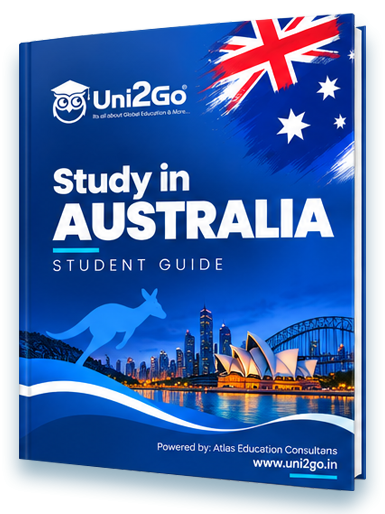
Get your free guide
Fill the required details and we'll send the guide to your email.
Frequently Asked Questions
As a part of the student visa application you will also need to get your health check-up done and provide proof that you are in good health. You can do so by providing a certificate of good health. The health check-up and certificate can only be provided by the Panel doctor in your city authorized by the Australian government.
| Study Level | Average Fee (Indicative) |
|---|---|
| English Language studies | A$270 to A$380 per week |
| Vocational Education (Certificated IV, Diploma & Advance Diploma) | A$ 14,000 to A$ 28,000 per annum |
| Bachelor's | A$ 25,000 to A$ 58,000 per annum |
| Graduate & PG Diplomas | A$ 25,000 to A$ 35,000 per annum |
| Master's | A$ 30,000 to A$ 58,000 per annum |
| Doctoral & PhD | Varies, scholarships can be avaliable |
Living costs:
Living costs include accommodation, food and bills, and clothing as necessary, and will vary according to your lifestyle. The Department of Home Affairs has financial requirements you must meet in order to receive a student visa for Australia. As of April 2021 the 12-month living costs are:
- For students or guardians - AUD $29,710
- For partners coming with you - AUD $10,394
- For a child coming with you - AUD $4,449
There are many scholarships, grants, and bursaries which can help support you financially with your studies in Australia. They are offered by the Australian Government, education providers, and a number of other public and private organizations. Below we have outlined some popular scholarships available for Indian students:
Australia Awards
The Australia Awards aim to promote knowledge, education links, and enduring ties between Australia and our neighbours through Australia's extensive scholarship programs. The program brings together scholarships offered by the Department of Foreign Affairs (DFAT), the Department of Education and the Australian Center for International Agricultural Research (ACIAR). Read more about Australia Awards.
Destination Australia
The Destination Australia Program (DAP) is the Australian Government’s new mobility program for domestic and international students to study in regional Australia. Over 1000 scholarships will be available each year to support both domestic and international students studying at regional campus locations in qualifications from a Certification IV level and above. Australian tertiary institutions will be able to apply for scholarships of up to $15,000 per student, per year. Read more here
Australian Government Research Training Program (RTP)
From 1 January 2017 the Research Training Program (RTP) replaced the International Postgraduate Research Scholarships (IPRS) program. Find out more about the Research Training Program at the Department of Education website. Applications for these scholarships are made directly to a participating university. Read more about RTP here
Provider / University scholarships
Almost all Australian universities and colleges provide a wide range of scholarships to meritorious international students to help them fund their studies. The primary criterion for most scholarships is a good academic score, however, it also depends on factors such as your chosen destination, subject and level. In some scholarships, factors like extracurricular activities, and volunteering can also be used to advantage.
Yes, Australian qualifications are widely recognised and respected internationally. Australian universities are known for their high academic standards, quality teaching, research excellence and industry-focused education.
However, certain professions, such as medicine, nursing, engineering, law and teaching, may require additional professional accreditation, registration or licensing to practise in Australia or other countries.
Australian Student Visa (Subclass 500) holders can generally work up to 48 hours per fortnight during academic sessions and unlimited hours during scheduled course breaks. Students pursuing a Master’s by Research or PhD can work unlimited hours once their course has commenced, subject to visa conditions.
After successfully completing their studies in Australia, eligible international students may have opportunities to remain in the country and gain valuable work experience. The Temporary Graduate Visa (Subclass 485) allows eligible graduates to live, study and work in Australia temporarily, generally for 18 months to 4 years, depending on their qualifications, nationality and visa stream.
The Temporary Graduate Visa (Subclass 485) includes three streams:
Post-Vocational Education Work Stream: Generally up to 18 months for eligible graduates with vocational or trade qualifications.
Post-Higher Education Work Stream: Generally 2 to 3 years for eligible university graduates. Under special arrangements for Indian nationals, eligible graduates may receive up to 4 years depending on their qualifications.
Second Post-Higher Education Work Stream: An additional 1 to 2 years may be available to eligible graduates who have studied and lived in designated regional areas of Australia.
In additon to this , Australia also offers various skilled migration and employer-sponsored visa pathways for eligible international graduates. These include the Skilled Independent Visa (Subclass 189), Skilled Nominated Visa (Subclass 190), Skilled Work Regional Visa (Subclass 491) and employer-sponsored visa options.
Eligibility for permanent residency depends on factors such as qualifications, occupation, skills assessment, English proficiency, age, work experience and relevant skilled occupation lists.
Important: Studying in Australia does not automatically guarantee a post-study work visa, employment or permanent residency. All visa applications are subject to the eligibility requirements and immigration policies in effect at the time of application.
Please visit :
Temporary Graduate Visa
Skilled Occupation List (SOL)
Overseas Student Health Cover (OSHC) is a mandatory health insurance requirement for international students studying in Australia. Students must maintain OSHC for the duration of their stay on a Student Visa (Subclass 500), including coverage for accompanying family members.
OSHC helps cover the costs of medical treatment, hospital care and certain healthcare services while studying in Australia.
The GS requirement is very important step and to be granted a student visa. All applicants must demonstrate that they satisfy the genuine student criterion. Under this all applicants for a student visa must be a genuine applicant for entry. They must stay as a student and be able to show an understanding that studying in Australia is the primary reason of their student visa. The GS requirement is also intended to include students who, after studying in Australia, develop skills Australia needs and who then go on to apply for permanent residence.
In the online student visa application form, students will be asked the below questions to address the GS criteria.
- Details of your current circumstances, including ties to family, community, employment and economic circumstances.
- Why you chose your course and why you chose Australia as your study destination.
- How you will benefit from studying your chosen course.
- Details of your study history in Australia (if any).
- If you are holding a visa other than a Student visa, you will need to give reasons for applying for a Student visa.
- Any other relevant information that you’d like to provide.
Based on the above the visa office will make a decision. Please note: Generic statements unsupported by evidence are not given significant weight in the GS assessment. This means it is important to provide evidence to support a claim made by the applicant.
The Australian Government wants to encourage international students to study and live in designated “Regional Areas” of Australia. Regional Australia is referred to as any area outside metropolitan areas of Melbourne, Sydney and Brisbane. This clearly means some cities (like Perth, Adelaide, Gold Coast, Canberra, New Castle, Bendigo, Toowoomba and Wollongong) previously considered as cities now will be included in the regional areas
There are also numerous other benefits to studying in regional areas that will be introduced in November 2019 and they are outlined below :
One of the main benefits for international students choosing to study in regional cities is that they get 5 extra points when they apply for permanent residence under any of the skilled category and priority processing. This will increase your chance of getting Australian permanent residency
Additional Year and Two on Post Study Work
Students who study at regional universities will get one year to two years extra post study work visa. This visa allows students to stay in Australia with full time work rights.
Lower Costs of Living
The cost of living in regional areas is much less when compared to major cities. Example: The rent for 2 bedroom flat in Toowomba costs around $1370 per month and its around $ 2200+ in Sydney
Discover the real Australia
From tropical forests to snow covered mountains to white sandy beaches, regional Australia has it all. You can explore Australia’s natural environment and take up a relaxed and amazing life style
Excellent facilities
All regional cities are very cosmopolitan as well, with same facilities and entertainment that you will find in the big cities (think health care, cinemas, sporting venues, restaurants, cafés, bars and shopping), so you can be sure to find everything you need. One of the main differences is that these regional cities are more relaxed, and you will feel as if you are part of a community rather than just one person in a big city
Special Scholarships
The Australian government has announced special scholarships under “Destination Australia” for students studying in regional universities. More details at Destination Australia
Top 15 Regional Cities and Towns in Australia for Indian Students
- Perth
- Gold Coast
- Adelaide
- Canberra
- New Castle *Toowoomba
- Bendigo *Darwin
- Hobart
- Cairns
- Ballarat
- Wollongong
- Geelong
- Albury
- Townsville
An overview of study visa application (Subclass 500) requirements is included below:
When applying for your student visa for Australia, you will generally need:
- Proof of enrolment (Electronic Confirmation of Enrolment )
- A valid passport
- Visa application fee
- Meet the Genuine Temporary Entrant (GTE) requirements
- Academic and work experience documents
- Evidence of your English proficiency skills (such as IELTS, PTE-A or TOEFL test scores)
- Meet health requirements
- Evidence of financial ability (tuition fees, living expenses, expenses for dependents, return airfare)
- Details of your health insurance policy (Overseas Student Health Cover)
- Statement of purpose
- Passport-sized photographs
If you are under 18 years of age, you will also need to provide additional documents such as parental consent.