
New Zealand offers a well-established education system known for its academic standards, practical learning and internationally recognised qualifications. With a strong focus on quality education and student development, New Zealand provides a range of study opportunities for international students.
New Zealand's education system is organised into three main stages:
Children generally begin school at age five, and schooling is compulsory between the ages of six and sixteen.
Tertiary education refers to education and training undertaken after secondary school. It includes vocational qualifications, certificates, diplomas, bachelor's degrees, postgraduate qualifications, master's degrees and doctoral research programmes.
Students can choose from different types of education providers depending on their academic background, career interests and future goals.
New Zealand has eight universities offering undergraduate, postgraduate and research programmes across a wide range of disciplines, including engineering, business, information technology, health sciences and the humanities.
These institutions offer career-focused education and training, combining academic learning with practical skills. Programmes may include certificates, diplomas and degrees in fields such as technology, business, hospitality and applied sciences.
Private education providers offer specialised programmes in various disciplines. Students should check that their chosen institution and programme meet the relevant quality assurance and approval requirements.
New Zealand has a nationally recognised qualifications framework that helps students, education providers and employers understand the level and complexity of different qualifications.
The New Zealand Qualifications and Credentials Framework (NZQCF) consists of 10 levels, ranging from introductory certificates to advanced doctoral degrees.
| NZQCF Level | Qualification |
| Level 10 | Doctoral Degree (PhD) |
| Level 9 | Master's Degree |
| Level 8 | Postgraduate Diploma, Postgraduate Certificate, Bachelor's Honours Degree |
| Level 7 | Bachelor's Degree, Graduate Diploma, Graduate Certificate, Diploma |
| Level 6 | Diploma, Certificate |
| Level 5 | Diploma, Certificate |
| Level 4 | Certificate |
| Level 3 | Certificate |
| Level 2 | Certificate |
| Level 1 | Certificate |
The higher the qualification level, the more advanced the knowledge, skills and learning outcomes expected.
Qualifications listed on the NZQCF are subject to established quality assurance arrangements, helping students and employers understand their academic standing.
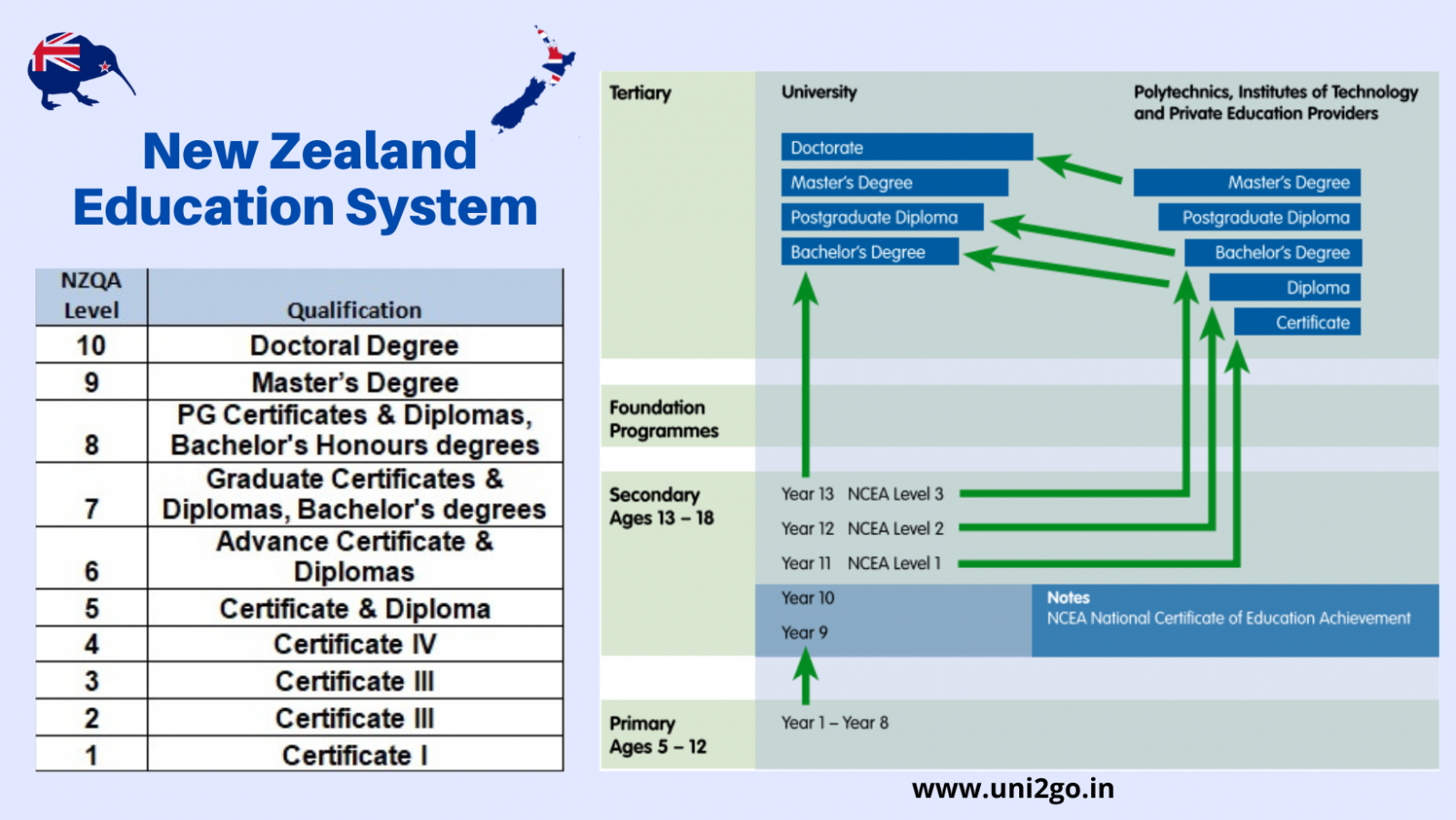
New Zealand's main secondary school qualification is the National Certificate of Educational Achievement (NCEA).
NCEA is generally completed across three levels:
Students completing secondary education may progress to university, vocational education or other tertiary study pathways, depending on their qualifications and entry requirements.
Indian students who have completed Year 12 can explore undergraduate study opportunities in New Zealand, subject to the admission requirements of their chosen institution.
Students who do not meet direct university entry requirements may be eligible for foundation or pathway programmes.
Students who already hold a bachelor's degree may consider graduate diplomas, postgraduate diplomas or master's degrees, depending on their previous qualifications and the programme's entry criteria.
New Zealand's education system provides opportunities to progress between qualifications, allowing students to develop their knowledge and skills over time.
Whether you are planning to pursue a bachelor's degree, master's degree or a specialised professional qualification, New Zealand offers a variety of educational pathways to help you work towards your academic and career goals.
Explore your study options in New Zealand with Uni2Go.
For official information, visit the New Zealand Qualifications Authority (NZQA). NZQA
Talk to the experts
 Mobile navigation